
The Asian Development Bank's existing education policy framework dates to 2002 — anchored in the Millennium Development Goals and an "Education for All" paradigm that assumed country-by-country sector strategies no longer adequate for today's regional realities. A more recent Directional Guide (2022) exists, but it is management-approved rather than board-endorsed, and by its own admission was written before climate became a central educational concern.
In the years since, the region's education challenges have diverged significantly. Developing Member Countries are simultaneously navigating unfinished first-generation issues — access, foundational learning, teacher availability, physical infrastructure — alongside a second layer of emerging demands: AI-ready curriculum, climate-resilient school systems, digital transformation, lifelong learning, and cross-sectoral skills development. No single framework credibly guides ADB's positioning across this full continuum.
The Independent Evaluation Department made it explicit in 2025: ADB needs a new board-endorsed education sector strategy, with stronger diagnostic work, clearer outcome frameworks, and a longer horizon. The Education and Skills Strategy 2035 (ESS 2035) is ADB's response — and the Design Labs series is the internal process through which that strategy will be built.
.jpeg)
How do you help an institution of pragmatists — economists, sector leads, results-oriented specialists — think beyond what is feasible today and toward what education could become?
Several tensions defined this engagement from the outset:
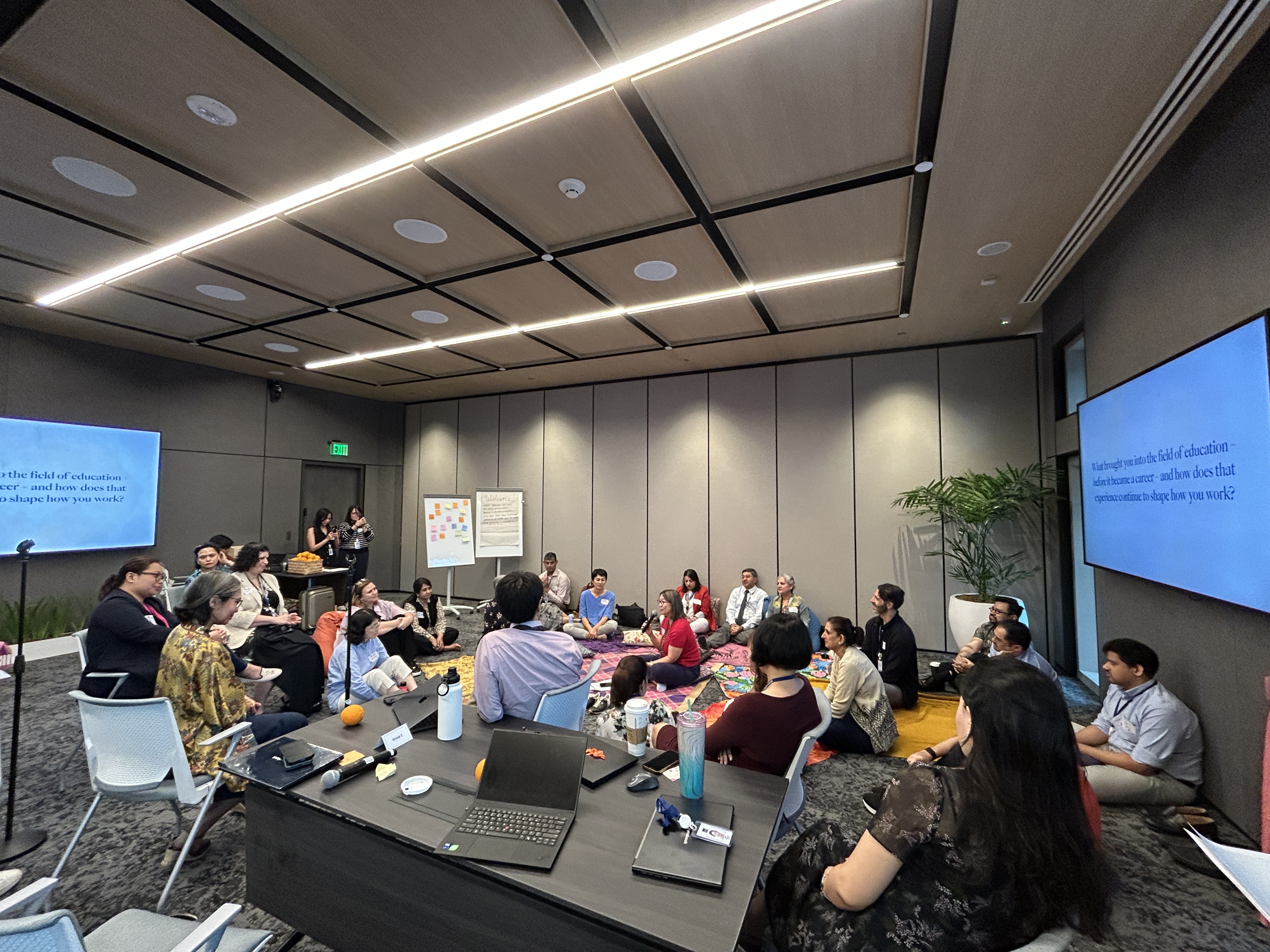
KindMind approached the ESS 2035 Design Labs through its Braver Learning by Design framework — treating the strategy-making process itself as a learning experience. The goal of Design Lab 01 was not to produce a strategy but to produce a room: a community of practice that had genuinely interrogated its own assumptions, named the signals it was seeing, and arrived at questions worth pursuing.
Two design principles anchored the lab:
Design Lab 01 ran across two sessions, each designed to contribute a distinct kind of knowledge to the overall picture.
The Signal Session — Online Pre-Session, 3 June 2026 The day before the in-person lab, KindMind facilitated an online pre-session with ADB Resident Mission specialists — people who work directly inside the education systems ADB supports across the region. Three facilitation groups ran simultaneously, moving through a Signals Studio sequence: naming signals of change from country contexts, sorting for the most interesting and wild-card observations, clustering into emerging trends, and projecting forward to 2035 through an Artifacts from the Future activity. Their vantage point was ground-truth: named schools, named countries, specific observations about learners, teachers, and governments in motion.
The Expedition — In-Person Day, 4 June 2026 The full-day in-person session at ADB Headquarters moved through four deliberate cognitive registers, each feeding the next:
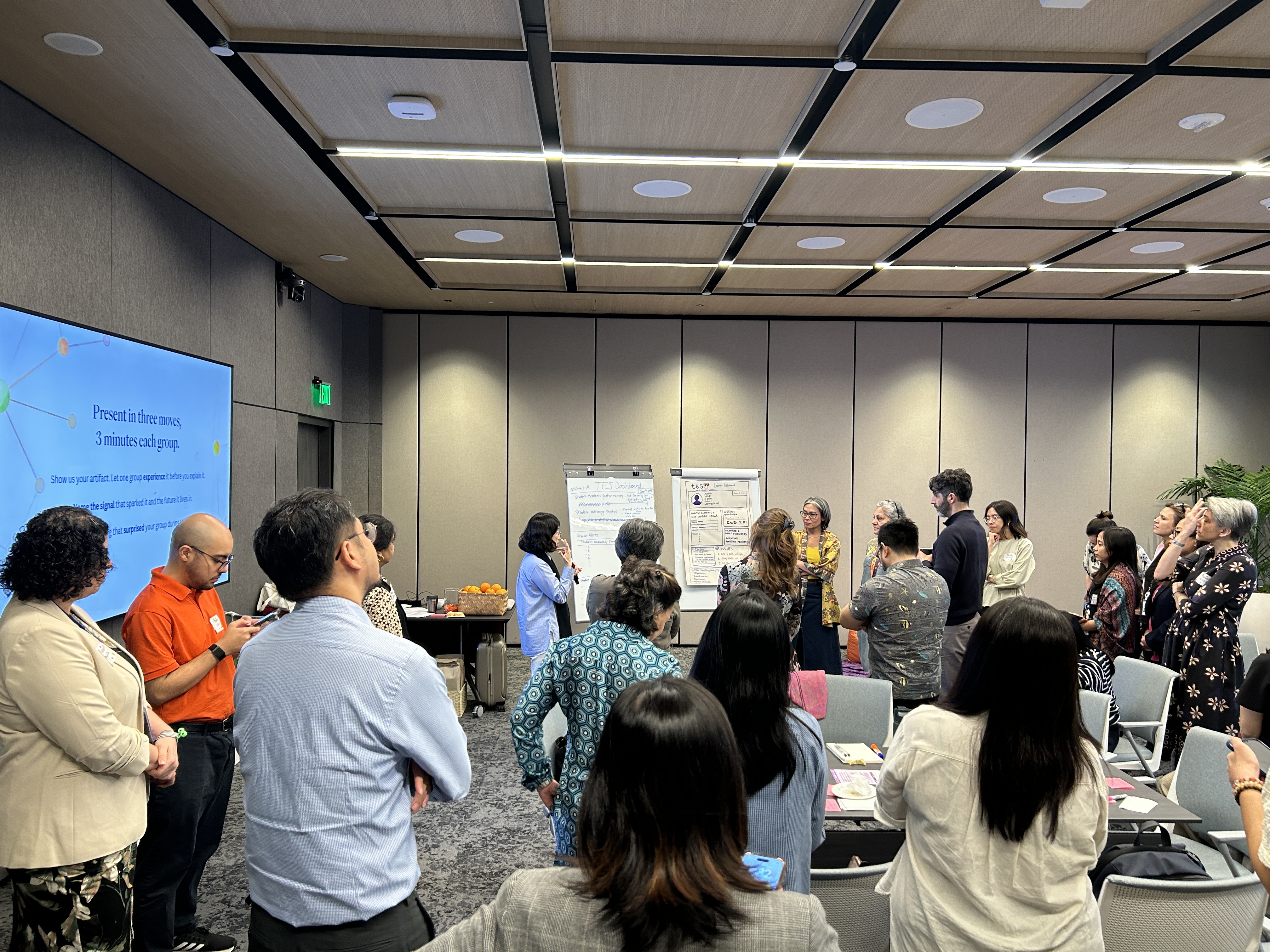
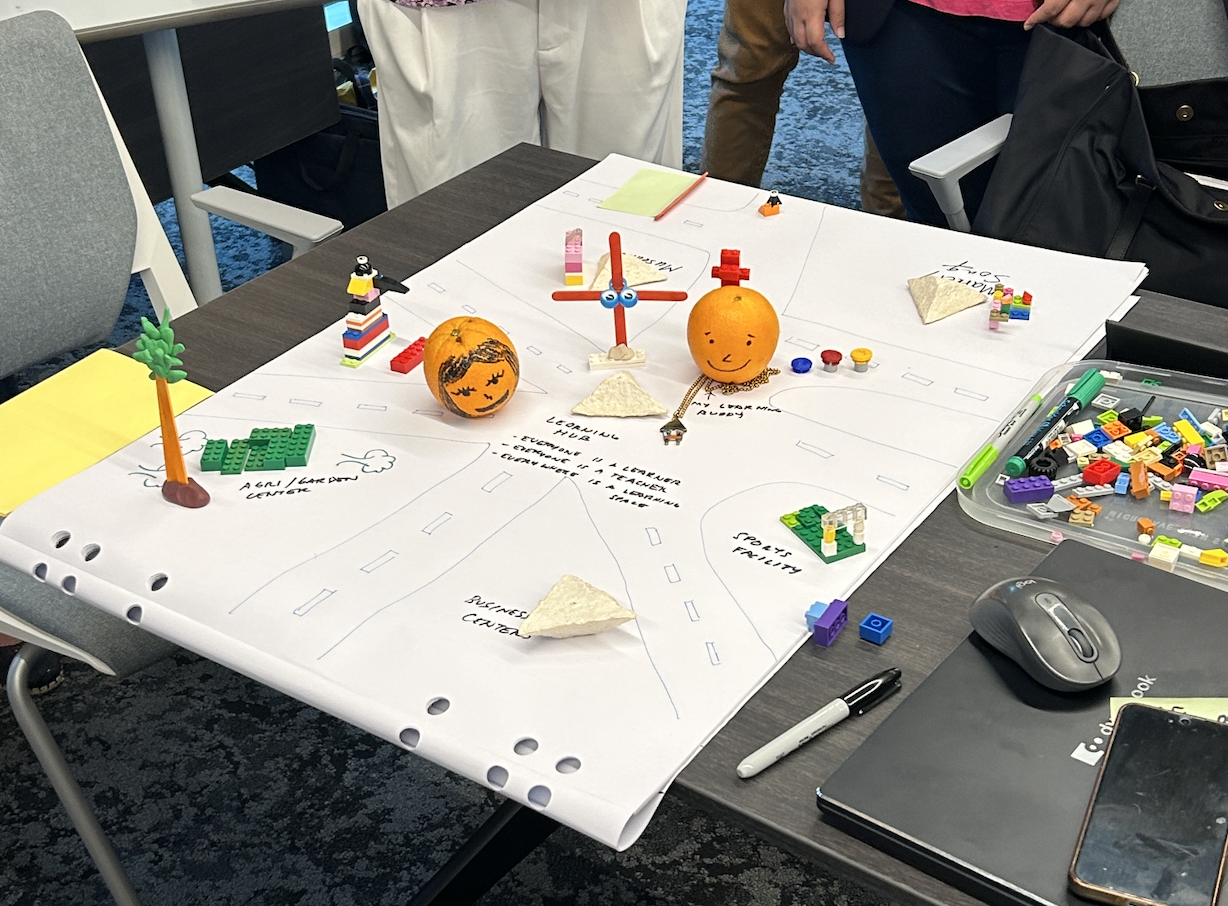
Seven groups, one convergence. Without coordinating across sessions or groups, all seven tables arrived at the same destination: a pull toward re-centring education on the human, in direct response to standardisation and AI. Group 1 redrew the system around the neurodivergent, individual learner. Group 2 organised everything around wellbeing and the whole child. Group 3 named it directly as a Human Renaissance. Group 4 ended with "everybody gets to learn; everyone thrives." The online groups added the ground-truth layer: the monopoly of formal education is quietly eroding; what remains uniquely valuable about schools when learning can happen anywhere?
That a room of pragmatists arrived there independently makes the convergence harder to dismiss. KindMind's field notes read it not as aspiration but as diagnosis.
A fault line named. In-person Group 3 gave the series its sharpest language: education built to extract rather than to build, develop, and regenerate. The room did not resolve this tension — it wrote it down honestly, which is the more useful thing. The extract-versus-regenerate frame now runs as a stress test through the rest of the Design Labs series: any strategic direction proposed in Labs 02 and 03 will be held up against it.
Five signals, structured for action. The synthesis distilled the room's outputs into five consequential signals for ESS 2035: learning is becoming distributed; AI is placing teachers and curriculum under permanent pressure; human connection is becoming more — not less — valuable as technology scales; learners are becoming more diverse than current systems are designed to serve; and resilience is becoming a core educational requirement, not a contingency. Each signal carries a How Might We question and a strategic implication forward.
A room ready for what comes next. What was perhaps most significant was the quality of engagement itself. Specialists who spend their days inside performance frameworks and project pipelines brought their working knowledge of how large-scale education actually lands — and pushed on what it would take for strategy to meet the real, diverse needs of learners. KindMind's read: this is a community that has already done the harder work of looking past the system it defends every day. Design Labs 02 and 03 do not need to convince them that change is worth imagining. They need to help them work the tension between the model they can already see and the system that currently holds.
ADB's ESS 2035 is not a document — it is a strategic bet on what education in Asia and the Pacific needs to become by 2035, and what ADB's role within it should be. The Design Labs series exists because that kind of bet cannot be made from a consultation report or a literature review alone. It has to be made by the people who will operationalise it, after they have genuinely interrogated their own assumptions and tested their thinking against multiple versions of the future.
KindMind's role is to design and hold that process: to create the conditions under which a room of pragmatic, results-oriented specialists can think beyond what is feasible today, name what they actually value, and arrive at strategic positions they are willing to defend. Design Lab 01 widened the field of view. Design Labs 02 and 03 will narrow it toward bets — tested against plausible futures, grounded in the signals the room itself surfaced, and honest about the tensions that strategy documents too often smooth over.
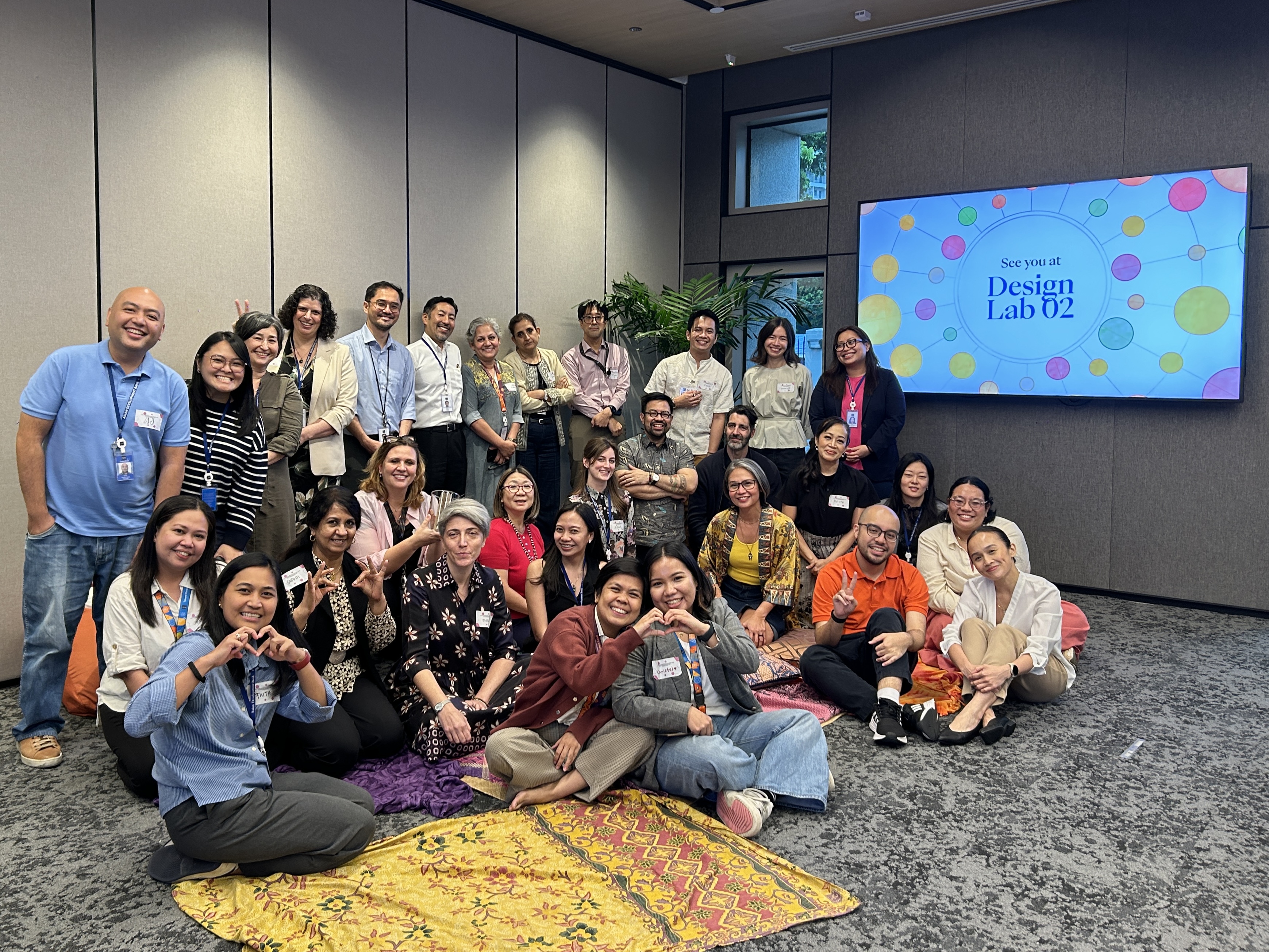
The ESS 2035 Design Labs is a three-part facilitated workshop series commissioned by the Asian Development Bank's Human and Social Development Department (HSD) to support the development of ADB's Education and Skills Strategy through 2035. The series is designed as a progressive arc: Design Lab 01 (Reimagining) widens the field of view through divergent thinking; Design Lab 02 (Envisioning) develops signals into plausible future scenarios and stress-tests strategic directions against them; Design Lab 03 (Sensemaking) converges on a portfolio of strategic bets and operational priorities for incorporation into the ESS 2035 concept paper. KindMind serves as the experience design and facilitation partner across all three labs.


